The IRS isn’t neutral. It nudges behavior.
Each of these accounts exists because the government wants something: retirement self-funded, healthcare managed, education pre-planned, families protected, and capital provided.
Tax planning isn’t about finding one perfect account. It’s about combining accounts with different rules so no single tax outcome controls your future. Most people think saving money is about discipline.
Save more. Spend less. Invest better.
That advice isn’t wrong — but it’s incomplete.
I meet a lot of smart, hardworking people who are doing everything right. They save. They invest. They avoid debt.
And yet, they still tell me the same thing:
“I’m earning more, but I don’t feel much more secure.”
Most of the time, the issue isn’t income or discipline. It’s where the money is sitting, and how the tax system treats it.
Because whether we like it or not, the IRS quietly rewards certain behaviors. If you save in the “right” places, you keep more. If you don’t, you give more away — even if you did everything else correctly. Let’s walk through the six types of accounts the IRS has built into the system, and why they exist, in plain English.
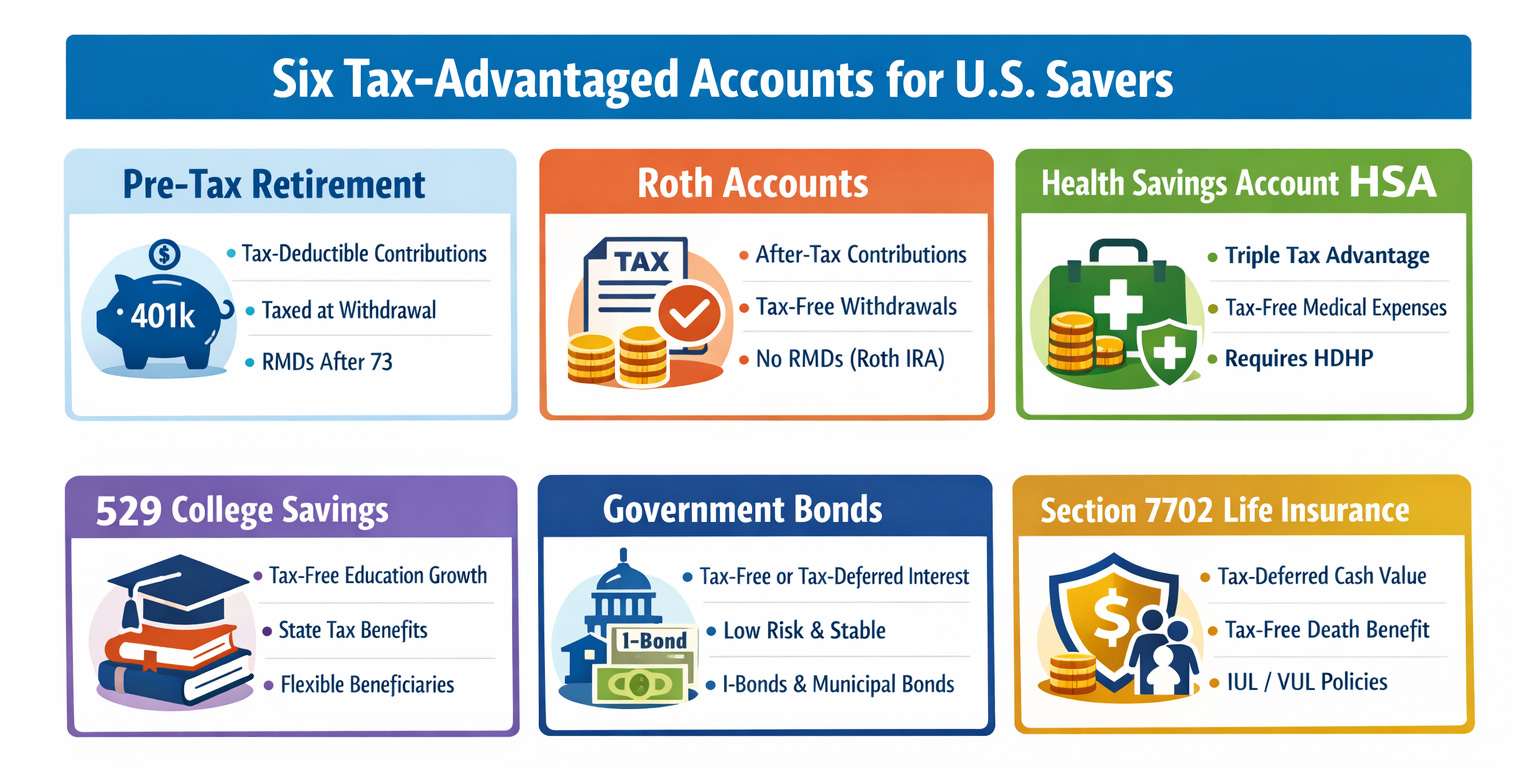
1. Pre-Tax Retirement Accounts
- 401(k), 403(b), 457, Traditional IRA, SEP-IRA, Solo 401(k)
What the IRS is encouraging:
👉 Delay spending today in exchange for tax relief now.
This is usually the first tax break people ever experience.
You put money in before taxes, your taxable income goes down, and the IRS says:
“Fine. We’ll tax you later.”
That’s the deal.
Why this exists
The government wants people to self-fund retirement instead of relying on social programs. So it rewards consistency and long-term saving.
The trade-off most people don’t think about
- You’ll pay ordinary income tax when you withdraw
- Required Minimum Distributions (RMDs) apply later in life
- Future tax rates are unknown
Pre-tax accounts are powerful — but they are a timing bet on taxes.
They work best when:
- Your tax rate today is higher than you expect in retirement
- You want immediate cash-flow relief
- You’re in peak earning years
2. Roth Accounts
- Roth 401(k), Roth IRA
What the IRS is encouraging:
👉 Pay taxes now so they don’t have to deal with you later.
At first glance, Roth accounts feel backwards. Why would anyone voluntarily pay taxes today?
But Roth accounts aren’t really about taxes — they’re about certainty and control.
Why this exists
The IRS gets its money upfront. In exchange, you get tax-free growth and tax-free withdrawals (if rules are followed).
Why people love Roth money later
- No tax bill when you need the money
- Roth IRAs have no RMDs under current law
- Much more flexibility in retirement planning
Roth works especially well if:
- You’re early in your career
- You expect higher income or higher tax rates later
- You want tax-free money as an option, not a promise
Think of Roth as insurance against future tax uncertainty.
3. HSA (Health Savings Account)
What the IRS is encouraging:
👉 Take responsibility for healthcare costs — and we’ll heavily subsidize you.
This is the most misunderstood account in the system.
Most people use an HSA like a checking account for medical bills. That’s fine — but it barely scratches the surface.
Why the IRS loves HSAs
HSAs are the only account with three (sometimes four) tax advantages:
- Contributions are tax-deductible
- Payroll contributions avoid FICA taxes
- Investments grow tax-free
- Qualified medical withdrawals are tax-free
After age 65, non-medical withdrawals are allowed (taxable, but no penalty), which makes an HSA function a lot like a retirement account.
The catch
- You must be enrolled in a high-deductible health plan (HDHP)
- Contribution limits apply
Used intentionally, an HSA can quietly become one of the most tax-efficient assets you own.
4. 529 Plans (Education Savings)
What the IRS is encouraging:
👉 Fund education privately instead of relying on public support.
Most people think 529 plans are just “college savings.”
They’re not. They’re really tax-planning tools wrapped in an education label.
Why this exists
Education is expensive, and the government would rather:
- encourage families to prepare early
- than subsidize everything later
What makes 529s powerful
- Tax-free growth for qualified education expenses
- Many states offer state-tax deductions or credits
- Special estate-planning benefits (including 5-year gift averaging)
Recent law changes even allow limited 529-to-Roth rollovers for beneficiaries — which slightly reduces the fear of “overfunding.”
A 529 isn’t just about tuition. It’s about who pays taxes, when, and for whom.
5. Government & Tax-Advantaged Bonds
(I-Bonds, Treasury Bonds, Municipal Bonds, TIPS)
What the IRS is encouraging:
👉 Lend to the government or public infrastructure — and we’ll tax you less.
These aren’t exciting. That’s the point.
How the tax benefits work
- U.S. Treasury Bonds / Notes / Bills Interest is exempt from state and local taxes (but taxable federally). This makes Treasuries especially attractive for high–state-tax earners who want safety without giving up after-tax efficiency.
- I-Bonds Interest is exempt from state and local taxes, tax-deferred at the federal level until redemption, and inflation-adjusted. In certain cases, interest may also be federally tax-free when used for qualified education expenses (subject to income limits).
- TIPS (Treasury Inflation-Protected Securities) TIPS provide inflation protection, and their interest is exempt from state and local taxes. (Note: inflation adjustments are taxable federally in the year they occur, even if not yet received — a reason many people hold TIPS in tax-advantaged accounts.)
- Municipal Bonds Interest is often federally tax-free, and if you live in the issuing state, it may also be state and local tax-free.
What people miss These are not return engines. They are tax and volatility management tools.
They matter most when you’re in a high tax bracket, want stability without fully giving up efficiency, and are managing large taxable portfolios.
“Boring” doesn’t mean useless. It often means strategic.
6. Cash-Value Life Insurance
(IUL / VUL / Whole Life when properly structured)
What the IRS is encouraging:
👉 Protect families — and we’ll treat insurance differently.
Life insurance sits in a separate part of the tax code for a reason.
Why this exists
The government wants families protected from catastrophic loss. So it gives insurance unique tax treatment: cash value grows tax-deferred, policy loans (up to basis, if structured properly) can be tax-free, and death benefits are generally income-tax-free to beneficiaries.
Important reality check
This is not an investment account. It’s a risk-management tool that can support tax diversification when designed correctly.
Poorly structured policies can fail. Well-designed ones can provide tax-advantaged liquidity, downside-protected growth features, and estate and legacy flexibility.
Context and design matter — a lot.
The Big Picture Most People Miss
The IRS isn’t neutral. It nudges behavior.
Each of these accounts exists because the government wants something: retirement self-funded, healthcare managed, education pre-planned, families protected, and capital provided.
Tax planning isn’t about finding one perfect account. It’s about combining accounts with different rules so no single tax outcome controls your future.
Final Thought
You don’t need to use every tax-advantaged account. You don’t need perfect optimization.
What you do need is awareness.
Because once you understand how the system actually works, saving stops feeling like effort and starts feeling like alignment.
That’s when financial progress finally feels… real.
And with that — enjoy the upcoming tax season. Or at least… feel a little less confused by it.
Written by
Peiyao Sun
Senior Retirement & Wealth Strategist
Peiyao is an experienced retirement and wealth strategist focused on helping individuals and families make confident, informed decisions about rollovers, annuities, and long-term financial protection. With over a decade of experience in financial modeling and planning, she translates complex retirement rules into clear, actionable guidance.
Get Personalized Investment Guidance
Let Elenvo analyze your finances and create a customized plan.